
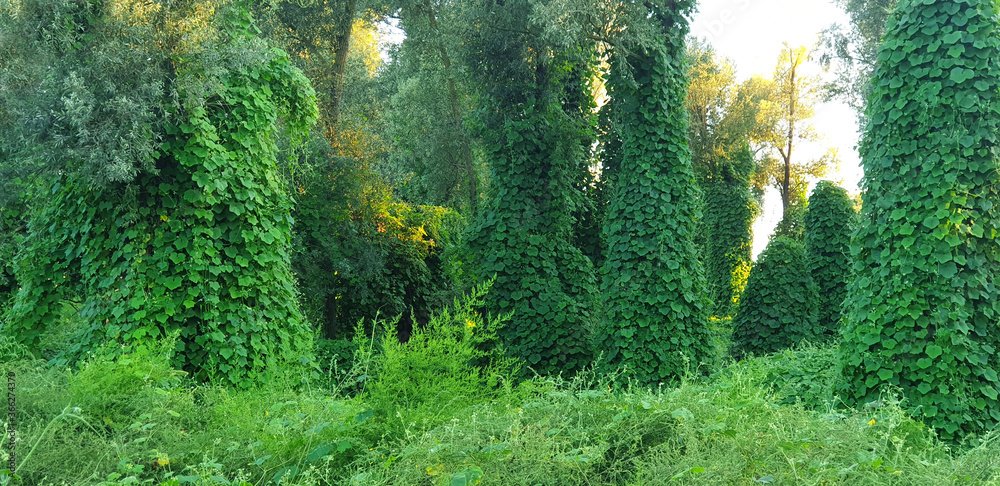
Good morning y’all! It’s a beautiful spring morning here in sunny Texas. As I so often do, I began my day considering the possibilities for my meals ahead, and how I might navigate this necessary caveat of life.
I, like many others, am affected by a number of concerns that have for some time complicated my relationship with food. Too many carbs, too little protein, too little fat, not enough iron, too much calcium, etcetera, etcetera. It’s enough to make life miserable if one were but to let it. However, I count myself fortunate that in my youth my parents fostered within me a deep love for learning, so I welcome the challenge most days.
As I work on cleaning up after my breakfast this morning, my thoughts shifted toward the state of the American diet, and the numerous health hurdles related to improper diet many in the world and our country are undoubtedly facing as the economic crises drags on.
I recalled an article I’d read in several years ago related to Kudzu, a leafy climbing vine related to the pea, that was introduced to America from Japan in 1876 as an ornamental, and later used during the Great Depression Era of the 1930s to combat the issue related to erosion caused by over-farming in the years prior. The internet is full of photos documenting how this tenacious climbing vine has completely decimated forests and homesteads across the southern United States. Sadly erosion control was not the best use for this plant, due to its shallow root systems. This plant has been known to raise global CO2 levels, and the deforestation it has caused has wreaked havok on the native ecosystems in the American south.
As we face the global food crisis in it’s third year, I thought I’d share my thoughts on how we might circumnavigate this issue from multiple viewpoints.
Kudzu is a heart healthy addition to the diet, that can easily replace many common nonclimbing varieties of greens in many dishes. I’m going to make it easy from here by using a list of the uses for this leafy green:
- Kudzu can be prepared raw or steamed or boiled such as with collards or spinach (Boil for ~60-120 seconds to wilt, then season to preference.) A few ideas are adding it to omelettes and quiches.
- High in antioxidants, this plant has reportedly seen historical use as a means to help better control blood glucose levels, as well as to help stave off the effects of alcohol cravings. You can accomplish this by utilizing as a food or as tea.
- The starchy roots can be harvested in the winter months and peeled, ground to powder to thicken soups, and baked or roasted like potatoes or other tubors.
- The red or purple flowers can supposedly be made into jelly. Having not personally tried this, I cannot attest to the flavor, but it seems as if recipes tend to call for 5cups(~180g) worth of blossoms to ~3 pints of jelly.
- Aside from the seeds and pods, the rest of the plant is edible.(Due to the tenacity of the plant, these pieces should be destroyed rather than composted to prevent them from germinating and becoming a nuisance in your garden and community.)
Hopefully by turning more folks onto the idea of adding this leafy green to their diet, we might make a sizable dent in that statistic in addition to aiding our cardiovascular health.
- Travel Issues: Chiggers
- On the matter of happiness; a musing
- From the Kitchen: Keto Breakfast Wraps
- Kudzu, The Vine That Ate the South: A tale of Drought, War, and Fighting Hunger
- Defining Success: It’s all About Perspective
If you liked what you read, please pay it ahead! It really helps!(I like to make doodads in my spare time, so you might just get a goodbye or two in gratitude!)
 Blaze the Daze
Leave a comment